


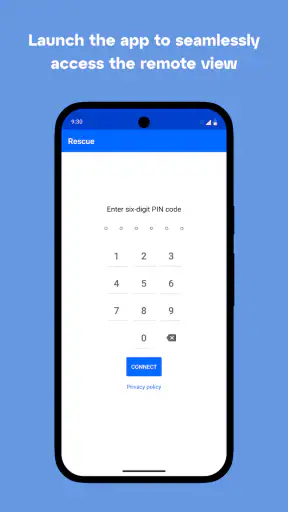
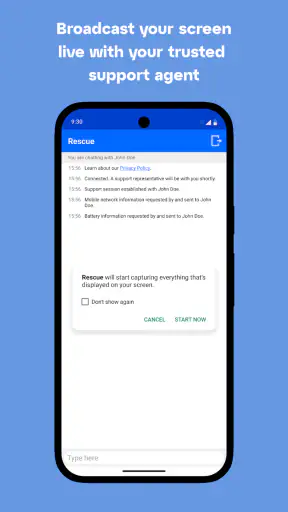
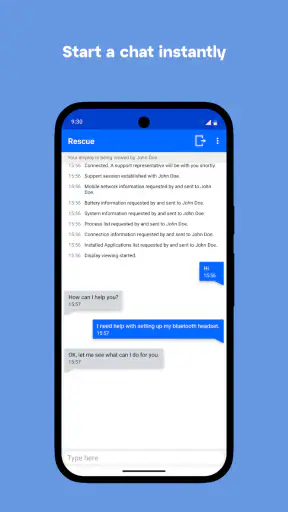
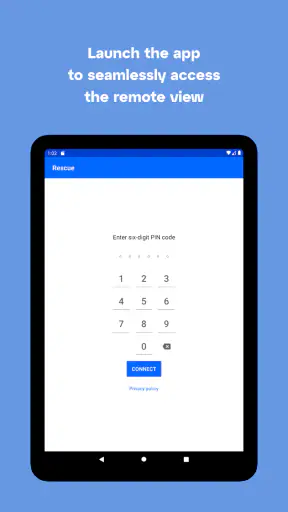
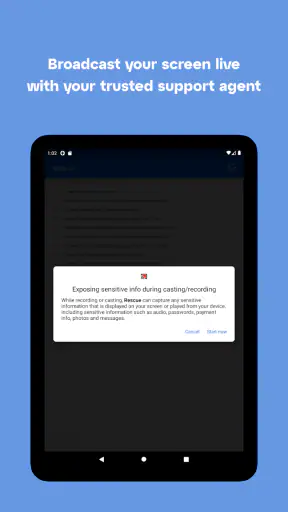
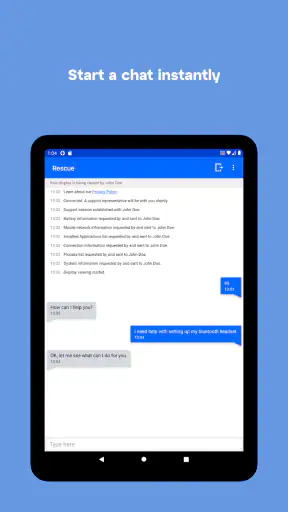
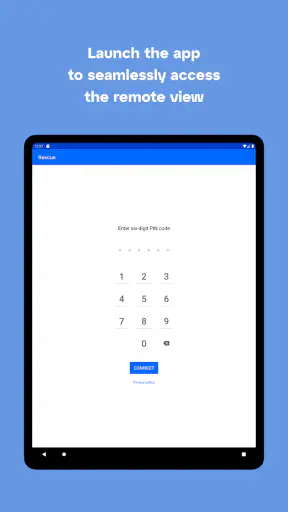
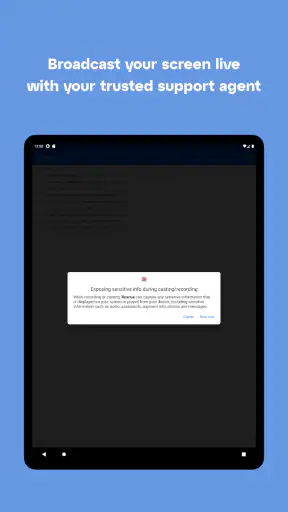
I approach LogMeIn Rescue Customer differently from a normal business app. It is not something I open to organize a project, write a report, or manage a team by myself. It is a secure support app designed to let a trusted technician help with a device, so its value appears at a very specific moment: when explaining a technical problem over the phone is taking longer than solving it directly.
That distinction matters before installing it. The app comes from GoTo Group, Inc., belongs to the business category, and is free to download. It is available for Everyone and has passed the point where an unfamiliar support tool feels experimental, with more than a million installs and a 4.7 average from roughly 5.8 thousand ratings. Those figures suggest a well-established product, but they do not change the most important rule: only use it with a technician you already trust.
In my experience, the best way to think about it is as one step in a support workflow. I would not keep it running casually or accept a session from an unexpected caller. I would install it when a legitimate support representative tells me exactly which app to use, confirms why access is needed, and stays available while the session is active. Used that way, it can remove a lot of frustrating back-and-forth. Used carelessly, remote support can expose far more of a device than a simple chat or phone call.
Where it fits before a support session begins
Why ordinary troubleshooting often breaks down
Most device support starts with a familiar routine. I describe what I see, the technician asks which menu is open, I read out error messages, and we try a few settings one at a time. That process is manageable when the issue is simple. It becomes tiring when the problem depends on a setting I cannot find, a screen that looks different from the technician’s instructions, or a sequence of actions that is difficult to explain accurately.
LogMeIn Rescue Customer is useful at that point because it changes the conversation from verbal instructions to guided assistance. Instead of trying to reproduce every tap in words, I can work with a support professional who has a clearer view of the problem. That can be especially helpful for people who are comfortable using a phone or tablet but do not enjoy navigating technical menus.
There is also a practical benefit for small businesses. A staff member working away from the office may need help with a device while the company’s support person is elsewhere. A remote support session can reduce the need to wait for an in-person visit. It is not a replacement for a complete help-desk system, but it can be a focused bridge between “something is wrong” and “someone qualified is looking at it.”
The trust check I would make first
Before I start, I would verify the technician through a channel I already recognize rather than trusting an unexpected pop-up, cold call, or message. I would ask what problem the session is meant to solve, what actions the technician expects to take, and when the session will end. These questions are not unnecessary obstacles; they define the boundaries of the support appointment.
I would also close unrelated personal or business material before sharing the screen or granting access. Even when the support request is genuine, a clean workspace makes accidental exposure less likely. If I need help with one application, I do not want private messages, documents, or account pages sitting open in the background.
The app’s secure-support positioning is reassuring, but I would never treat the word “secure” as permission to skip judgment. Security includes the identity of the person on the other side, the reason for the session, and my decision to stop when the request no longer matches the original problem. The safest workflow is a short, supervised appointment, not permanent access or an open-ended conversation.
A realistic everyday scenario
Imagine that I am helping a family member whose device has stopped connecting properly to a work service. They can describe the symptom but cannot find the setting the support team needs to inspect. A technician sends clear instructions for installing the customer app, remains on the phone, and explains each step before proceeding. Rather than asking my family member to read every menu label, the technician can guide the session directly and focus on the actual issue.
That scenario shows the app’s strongest use case: a trusted expert helping a willing customer through a problem that is difficult to communicate remotely. It is less useful when the issue is already easy to solve with a short written guide, because installing a support tool and arranging a session would add needless steps.
What I prepare before opening it
I would have the device charged, a stable connection available, and the support contact’s instructions in front of me. I would avoid starting a session while moving between networks or when I have only a few minutes, because interruptions can make troubleshooting harder. I would also make sure I understand how to end the session myself rather than assuming the technician will do it.
That preparation turns the app into a deliberate part of a sustainable productivity system. It prevents a technical issue from expanding into a long, improvised support exchange. The goal is not to use remote assistance more often; it is to use it at the right point, with enough preparation that the session solves a defined problem instead of creating confusion.
How I organize the support process around the app
Capture the problem before the session
The app itself is not a project notebook, so I would capture the important details elsewhere before connecting. I would note what stopped working, when it started, what changed recently, and what I have already tried. A short timeline is more useful than a long emotional description. If an error message appears, I would record its wording carefully or keep a screenshot ready, while making sure the image does not include unrelated private information.
This small preparation has an overlooked advantage: it keeps the session focused. When a technician asks what happened, I can answer without reconstructing the entire story under pressure. It also helps me recognize whether the proposed fix actually addresses the original issue or merely changes something unrelated.
I would separate facts from guesses. “The connection failed after restarting the device” is useful. “The update definitely damaged everything” may be a guess. That distinction gives the technician better material and reduces the risk of making unnecessary changes based on an assumption.
Use a simple session boundary
I find a three-part boundary helpful: purpose, access, and finish. The purpose is the exact problem being investigated. Access means understanding what the technician needs to see or control. Finish means knowing what successful resolution looks like and how the session will be closed.
For example, if the purpose is diagnosing a business application, I would not agree to unrelated account changes simply because they become visible during the session. If a new issue appears, I would pause and ask whether it needs a separate appointment. This is one of the most useful habits around remote support: scope control is part of security.
I would also ask the technician to explain unfamiliar prompts before I approve them. A legitimate professional should be able to describe why a step is needed in ordinary language. If the explanation becomes evasive, urgent, or unrelated to the original problem, I would end the session and contact the organization through its official support route.
Turn the outcome into a reusable record
After the session, I would write down what was checked, what changed, and what I should do if the same symptom returns. This is where the app becomes part of a repeatable routine rather than a one-off rescue. The record does not need to be complicated. A few lines can prevent me from repeating the same diagnostic conversation later.
For a household, that note might include the device involved and the name of the service that needed attention. For a small team, it could become a short internal support history. I would avoid storing sensitive access details in that note, especially passwords or codes. The useful information is the procedure and the result, not credentials.
This post-session capture also reveals when remote support is no longer the right tool. If the same failure returns repeatedly, I would ask for a deeper root-cause investigation rather than scheduling endless rescue sessions. Remote assistance is excellent for removing a blockage; it is not automatically a maintenance strategy.
Build a routine that does not depend on memory
My repeatable routine would look like this: verify the support contact, define the problem, prepare the device, start the supervised session, confirm the result, end access, and record the resolution. The sequence is intentionally plain. A support app should reduce mental load, not require me to remember a complicated operating procedure.
I would keep the app installed only if I regularly receive support from an organization that uses this method. Otherwise, I would install it when instructed through a trusted channel and remove it later if it no longer serves a purpose. That approach keeps my device less cluttered and makes each installation intentional.
The current version is 8.10.2-46, and the app supports devices using Android 7.0 or later. I would check compatibility before asking someone else to depend on it during an urgent session. Compatibility is a small detail, but discovering a device limitation after a support appointment has started is exactly the kind of avoidable friction a good workflow should prevent.
Where it differs from ordinary alternatives
Compared with a phone call, this app can make visual diagnosis and guided assistance more practical. A call is still better when the issue is a simple explanation, when the device contains material I do not want to show, or when connectivity is unreliable. Compared with written instructions, remote assistance can be faster for a person who cannot locate the required setting, but written steps are easier to save and repeat independently.
It also differs from general-purpose video calling. A video call may let a technician see the physical device through another camera, but that is not the same as a support-focused session. On the other hand, a normal call may feel more familiar to a cautious user who does not want to install a specialized tool. I would choose the least invasive option that can realistically solve the problem.
For an organization with a full internal help desk, ticketing, device management, and established remote administration, this customer app may be only one small part of the support experience. Its appeal is not that it replaces every alternative. Its appeal is that it gives a customer a direct route into a technician-led session when ordinary instructions are not enough.
Failure points I would plan for
Trust can fail before technology does
The most serious weakness is not a missing convenience feature; it is the possibility of giving access to the wrong person. A convincing caller can use a legitimate support tool for an illegitimate purpose. That is why I would never search for a technician through an unsolicited contact and then install the app simply because the person sounds confident.
I would independently confirm the organization, avoid sharing passwords, and stop if the technician asks for information unrelated to the stated repair. I would not allow pressure to turn a routine support session into an emergency. If I feel rushed, I would end the interaction and start again through a trusted channel.
Remote help can feel intrusive
Even with a legitimate technician, seeing someone work through a device can feel uncomfortable. I may not know exactly what is visible at each moment, and I may worry about accidentally opening something private. Preparing a clean screen and staying present helps, but it does not remove the need for awareness.
I would treat the session as supervised access, not as a chance to leave the technician alone with the device. If I need to step away, I would end the session first. That may sound cautious, but it is a sensible trade-off for an app whose whole purpose is to connect a customer with technical assistance.
Connection and communication still matter
A remote session cannot overcome every practical problem. A weak connection, a device that is nearly out of power, or unclear instructions can still derail the appointment. The app may make the technician’s work easier, but I still need to communicate clearly and respond to prompts. If the issue is caused by hardware damage, a network outage outside my control, or a service-side failure, remote guidance may only establish what needs to happen next.
I would also avoid assuming that a successful session means the underlying system is permanently fixed. I would test the original task, not just accept that a setting was changed. If the problem affects work, payments, communication, or access to important files, I would keep a backup plan until normal use has been confirmed.
When I would choose something else
I would skip this app when the support provider cannot be independently verified, when the request involves highly sensitive material that does not need to be shown, or when a clear official guide can solve the issue without remote access. I would also choose an in-person technician for physical repairs and a standard phone call for a quick question that does not require device inspection.
It is not the right choice for someone looking for a personal productivity planner, a permanent remote desktop tool, or a way to monitor another person’s device. Those expectations point toward entirely different kinds of software and, in some cases, raise serious consent concerns. This app makes sense only inside a legitimate customer-support relationship.
Who should adopt it and how I would decide
Good fit for guided, technician-led support
I would recommend it to people who regularly need help from a trusted support team and find spoken instructions difficult to follow. It can be particularly useful for families assisting relatives, small businesses supporting staff at a distance, and customers dealing with settings that are hard to describe accurately.
The free price lowers the barrier to trying it when a legitimate technician requests it, while the Everyone age rating makes it broadly accessible. Still, free does not mean consequence-free. The important cost is attention: I need to stay involved, understand what is happening, and protect information that appears on the device.
The app also suits users who value a structured support appointment. When I define the issue in advance and record the result afterward, the session becomes part of a dependable system. That is more sustainable than repeatedly calling support without notes and starting from the beginning every time.
Not ideal for independent troubleshooting
I would not suggest installing it just to explore remote assistance or hoping it will diagnose problems automatically. Its usefulness depends on a technician being involved. Someone who prefers solving issues through manuals, community discussions, or self-guided settings may find a support session more intrusive than helpful.
It is also a poor fit for people who cannot verify the identity of the person requesting access. In that situation, the correct decision is not to find a clever way to use the app more safely; it is to avoid the session altogether and contact the relevant organization independently.
My final assessment
LogMeIn Rescue Customer is a focused business support tool rather than an everyday app. I like it most when the problem is real, the technician is trusted, and verbal instructions have reached their limit. Its strongest contribution is reducing the distance between a customer’s description of a problem and a professional’s ability to investigate it.
My recommendation comes with clear conditions: prepare before connecting, keep the session within a defined scope, remain present, and confirm the result afterward. If those habits fit your situation, the app can make remote troubleshooting much less frustrating. If they do not, a phone call, written guide, or in-person visit may be the wiser option.
For me, the deciding question is simple: do I have a verified support relationship and a specific problem that benefits from guided remote help? If the answer is yes, this free app is a practical addition to that workflow. If the answer is no, I would leave it unused rather than create a reason to grant remote access without a clear need.


